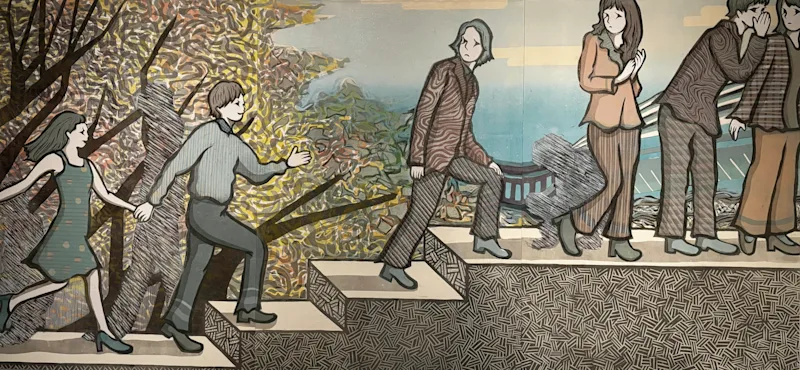
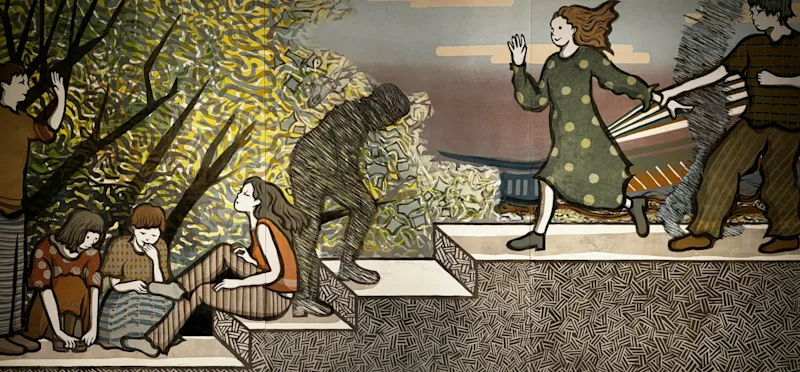
Social structures assign us positions and demand choices. To strive upward, to remain in place, or to take a different path—examining the weight of these choices and what lies beyond them forms the core of Michimata Aoi's practice.
"Kafka's Staircase" is a concept proposed by social activist and writer Ikuta Takeshi. Descending the stairs step by step—losing employment, losing one's address, ending up on the streets—is easy, but the staircase back to one's former life rises like a wall. Referencing this concept, Michimata has depicted the difficulties of ascending, descending, and remaining in place within picture-book-like, gentle imagery.
Yet the inquiry does not stop at "the staircase one cannot climb." Away from the social pressure to ascend, there is relief in belonging somewhere. That relief is indeed necessary, yet it is inseparable from the anxiety of remaining there indefinitely. Standing at a crossroads, making choices, and the belonging and stagnation that follow—the artist's concerns have developed toward these questions.
In her practice, Michimata progressively carves while layering impressions. The woodblock changes with each printing, and although edition numbers are assigned, the same image cannot be printed after completion. Once you move forward, you cannot return. This irreversibility is not unrelated to the themes of descending the staircase and making choices.
The figures depicted in her work do not tell dramatic stories. Within a gentle visual language, they simply exist. Michimata intends this quietness to open a space where each viewer weaves their own narrative.